In the early Broad Cove days, my aunt Wanda kept a car seat in the back of her blue Toyota Tercel because she would often take me out there, to her house. There’s a photo of me as a baby swaddled in a bath towel, in her partner Lynn’s lap on the rocky beach. Lynn is a soft-spoken woman with a gentle demeanour; she used to read me bedtime stories with Wanda’s fluffy Samoyed curled up at the foot of the bed. I remember Lynn wearing pastel-coloured turtlenecks and a short, fluffy hairstyle reminiscent of Princess Diana. In the mornings, Wanda would make us pancakes studded with berries from bushes near the house. It wasn’t until recently that I learned that Wanda and Lynn had applied to foster a child around this time. In spite of my aunt’s social work degree and years of experience working with children and young adults, and Lynn’s experience as an educator to children with learning disabilities, their application was rejected.
Wanda bought her house in the former fishing community of Broad Cove, Newfoundland, in the spring of 1989, one year before I was born and three years before life on the island was irrevocably changed by the northern cod moratorium. In 1992, the federal government announced the closure of Newfoundland’s inland northern cod fishery. In the three decades since the moratorium was put in place, Newfoundland and Labrador has maintained the highest per-capita unemployment rate in the country, leading to huge waves of out-migration, with many people leaving in search of work on the mainland. Today, Broad Cove is like a lot of rural Newfoundland: the locals who are left are mostly seniors, and many family homes either sit empty or have been bought by townies or mainlanders who use them for summer vacations.
In the years that followed Wanda’s move, many of my aunt’s lesbian friends bought houses on the same shore. Eventually, the group coalesced into an informal queer community, who take care of each other emotionally and pragmatically. Despite being denied the opportunity to adopt a child, Wanda and Lynn made a family in Broad Cove. Wanda tells me, “We support each other, if anyone needs anything. If someone’s sick then someone’s putting on a pot of soup, which is the way rural Newfoundland used to be.”
*
When I was a child, you could often hear the organ from the church in Broad Cove throughout the community. Today, the church is no longer operational, and an eerie red light (presumably from an exit sign still glowing somewhere inside) shines through the windows at night.
My grandmother was very Catholic, and the Church played a huge role in her family’s life. When Newfoundland joined Canada in 1949, the federal government negotiated with the Church to allow them to continue controlling the school system, if the Church agreed to stop telling their congregations to vote against Confederation. It wasn’t until 1998 that the province’s school system became fully non-denominational.
Like many Newfoundlanders of their generation who witnessed the systemic abuse of children by the Church make headlines, my parents are atheists and deeply critical of institutionalized Catholicism. According to family lore, when my parents refused to have me baptized, my grandmother secretly did it herself in the back seat of her car with a small bottle of holy water. Despite my grandmother’s efforts, I’m not religious and see the Church as a perpetrator of colonialism, child abuse, homophobia, transphobia, and misogyny. But it’s hard to consider how growing up in a culture that was influenced by the institution for so long has shaped me in ways I might not even recognize.
*
Growing up, I was lucky to be doted on by Wanda’s crew of butches, who let me ride shotgun in their big trucks and cling on to the back of their quads as they sped along cliff-side trails.
We rarely see representations of rural queers, and when we do, they are usually depicted as scheming an escape to the big city, where they will finally be able to “be themselves.” However, for my aunt and her friends, their lesbian identities are tied to living in outport Newfoundland, and my own lesbian identity has been shaped by them. These women chop and stack wood for winter, they can diagnose a car problem by ear, and they know how to handle a four-wheeler. The music, dialect, sense of humour, and resourcefulness often associated with this particular island in the North Atlantic feel intertwined with their queerness. For example, in Newfoundland, women are sometimes called “maid” as a term of endearment. After Wanda had been living in Broad Cove for a few years, she learned that the locals were referring to the quad path that runs alongside her house as “Lick-a-Maid Lane.” The lesbians were quick to adopt the phrase themselves. Within this joyful and culturally rich context, I came to understand that I might be gay too.
Like me, Wanda grew up in the island’s capital, St. John’s, but she always loved the expansiveness of the landscape in rural Newfoundland. As a child, she went with her family on an annual trip to visit a great-great-aunt who lived alone in the tiny community of Heart’s Content. Her aunt’s independence and the vastness of the ocean just outside her small house made a big impression on Wanda. She was struck by how different it felt from the suburb alongside the Avalon Mall where she grew up.
Wanda and Lynn would take me to the Trestle, a swimming hole named for the train bridge that collapsed into it decades before. Newfoundland Railway stopped passenger service in 1969, and since then, many of the rail beds have been covered with gravel and turned into backroads and ATV paths. I was allowed to ride in the pan of the truck on the dusty trail to the Trestle. Locals piled rocks in the river to create a dam that enhances the natural pool at this spot. People would show up with bars of soap and shampoo to wash there. Young kids paddled near the shallow edges and bigger kids jumped off the cliffs above the swimming hole, causing the adults to gasp and scold. There were often empties piled near a fire pit at the mossy edge of the pool, a reminder of what teenagers had been up to the night before. Like most rural swimming spots, the warm, clear water was haunted by the rumour of a drowning years before.
I live in Montreal now, and while I love a sweaty dance floor crowded with queers (to me, a definitively big-city experience), I often miss home. The bay has always felt magical to me, in part because of the life Wanda built for herself out there. For as long as I can remember, Wanda has been hosting parties in Broad Cove. They’re all-day affairs where the table is loaded with salads and desserts. Outside the air smells of barbecue and salty ocean, sometimes a hint of weed. The driveway is blocked with pickups and ATVs. Dogs run in a pack around the fenced-in yard, and children play on the swing set Wanda built behind the house. In the evening, people gather in the shed for music and dancing.
*
There’s a drawing my aunt’s best friend and former roommate Steve Bassett made when they were teenagers, which he placed in a frame from the thrift store and gifted to her. Steve’s drawing is a pencil crayon rendering of a house with a shed surrounded by a short fence. There are two blue-green pine trees out front. In the background, overlapping hills reveal a glimpse of ocean on the horizon.
When Wanda and Steve met in high school in the 1970s, he was already out. Before she realized that she was also gay, Wanda was drawn to Steve, and they became inseparable. One night, Steve came to pick Wanda up and her father answered the door. Wanda watched her father’s eyes dart from Steve’s long leather coat and neatly styled hair to Wanda’s lumberjack-style plaid and work boots.
Steve’s drawing was a representation of the dream house that Wanda had described to him when they were teenagers. He included a little shed on the side of the house because Wanda loves sheds. Early in their friendship, the two of them would spend their weekends driving out around the bay, picking furniture out of the garbage, admiring old windows and doors, and coveting the sheds. In Newfoundland, sheds are sacred spaces where people gather to share advice on repairs and matters of the heart, to drink, and dance. Wanda and Steve imagined that someday, they might live together in a house like the one from Steve’s picture. I think that part of what attracted Wanda and Steve to rural Newfoundland was a belief that out there, they might escape some of the homophobic surveillance they experienced in town, by virtue of there being fewer people around and fewer people they knew.
The house Wanda ended up buying in Broad Cove is an actualization of Steve’s drawing of their dream home, down to the little shed on the side. Steve only got to visit Wanda in Broad Cove a couple of times before becoming too ill with AIDS to make the trip and eventually passing away from the disease. Wanda believes that if it weren’t for the stigma that surrounded AIDS at the time, Steve might have sought treatment earlier and survived. “People had this great fear. There were a lot of religious people who felt that this was God’s way of weeding out all the gay people. And what was coming for the lesbians next, right?”
Wanda’s shed is packed with folk art and hand-carved wood furniture she’s been gleaning for years. Wild roses poke their heads up over the window ledge, and beyond the flowers, a grassy field stretches a kilometre or two before dropping vertiginously into the ocean. In July and August, it’s not uncommon to see humpbacks breaching out there. People bring their beers to the shed and Wanda breaks out her fiddle. She and many of her friends played in folk and traditional Newfoundland bands in the ’80s and ’90s. Women join in on guitar, mandolin, and accordion. People call out the tunes they want to hear and everyone is encouraged to stamp and sing along. Sometimes a jig breaks out. As I’ve gotten older, I’ve come to appreciate these scenes more as one model of what aging might look like outside of a heteronormative family.
*
My aunt first learned to play music as a kid through the Catholic Church. My grandmother signed her up for violin lessons, and once a week she would practice at a nunnery, a place that felt cold and strictly regulated to Wanda. “They were kinda tough on you, Eva. They didn’t make it very fun. The most fun I had was down in the rec room by myself when I could just completely go somewhere else and get lost in the sound. So I quit.”
Wanda didn’t come back to music until she was in her early twenties, when she was studying social work at Memorial University of Newfoundland. One day, she heard Figgy Duff, a revered folk band, playing in the Thomson Student Centre. Figgy Duff played traditional Newfoundland music, a genre that Wanda had only ever heard once a year when the family visited her uncle for Christmas.
“Uncle Basil had a Harry Hibbs record that he used to play and that’s the only time I ever heard that music. Didn’t have it in our house. Didn’t hear it on the radio. Because we were in that period where we were ashamed of [our music], it wasn’t as good as other people’s.”
After hearing Figgy Duff, Wanda went back to her parents’ basement, the place where she’d first been able to completely lose herself in music, free from the structured approach of lessons at the nunnery. She found her childhood violin down there. It was too small, but she practised on it for a while anyway. Through teaching herself to play traditional Newfoundland songs, Wanda explored the sound of the instrument on her own terms.
Traditional music offered Wanda a sense of freedom and self-determination in the same way the expansive landscape of the bay did. She and Steve were living together in a three-story house on Gower Street in St. John’s when Wanda started playing the fiddle. “I started learning the fiddle and nearly drove poor old Steve Bassett mad. I lived on the third floor, remember? And I thought, ‘I gotta get that Rufus tune!’ I worked on that for months, Eva, ’cause our music is a little different. I was up on the third floor banging my foot, thinking, ‘I’m getting it, I’m getting it, I’m getting it.’ And after three months, I got it.”
Wanda was part of a three-piece, all-lesbian folk group called the Prodigal Daughters. And later, she helped form the Barking Kettle, a band named for a large pot where fishers boil twine nets to help them withstand the corrosiveness of salt water, an apt metaphor for the resilience of outport Newfoundland culture.
“That was back in the heyday, Eva, when we were starting to realize, actually, we do like our culture, particularly our music. Like, hello? We were hiding it for a long time.”
The Barking Kettle toured rural Newfoundland, staying in motels and performing in community halls. Even when I baited and prodded, Wanda refused to indulge in any bragging about her band. However, her collection of old show posters revealed that the Barking Kettle played alongside heavy hitter Newfoundland musicians of the era like Kelly Russell and Figgy Duff.
The archive shows there was clearly a lot of appreciation for the Barking Kettle in town, but some of the outport communities they visited were less receptive. Wanda remembers an incident in a bar in Placentia Bay, when her bandmate Brian took out his bodhran as they were setting up, and a man started yelling across the hall, getting nasty and mocking him. It was a time when people in St. John’s were revelling in traditional outport culture, especially its music, while lots of rural Newfoundlanders had moved on to country and rock.
My aunt’s fascination with outport Newfoundland is partly aesthetic—she has an affinity for the objects, architecture, and music of Newfoundland’s past. On those long drives as teenagers, she and Steve were looking out for old houses. Later, when she found her house in Broad Cove, she chose it because it had original features like porcelain light fixtures.
*
The empty meadows that stretch into the background of Steve’s drawing were part of Wanda’s wish-landscape; a place where the two of them might have escaped the suffocating homophobic culture the Church imposed.
Ultimately, it was my aunt’s time working at Mount Cashel Orphanage, which was run by the Congregation of Christian Brothers, that led her to finally act upon her lifelong desire to live in rural Newfoundland.
Four months after Wanda started at Mount Cashel, an article was published in the Sunday Express, revealing that the Royal Newfoundland Constabulary had covered up allegations of widespread, systemic physical and sexual abuse enacted by the Christian Brothers on the boys in their care.
Wanda felt uncomfortable from the moment she walked into the orphanage; she found it cold and clinical. Even before she learned about the abuse, she felt the orphanage needed to close because of the unpleasant atmosphere. “I think [the Brothers] knew this was coming down the pipe and it’s one of the reasons that I got hired. They started hiring people from the outside, like me, to come in, almost to normalize this setting…”
Although Wanda was trained as a social worker, she wasn’t hired in that capacity at Mount Cashel. She carried out daily activities with the children, like getting them ready for school and helping with their homework.
Later, after the abuse became public, she was part of the team who helped transition the boys into other living situations. It cemented her belief that social workers should help children maintain a connection to their families, even if those families have been deemed unsafe by the state. It also complicated her understanding of the power of the Catholic Church.
“I learned about power when I was at Mount Cashel because there was a certain power that those Brothers had that was, of course, connected to religion, which was wrong. I knew it was wrong. I was starting to make those connections.”
Media teams descended on the orphanage after the abuse was exposed. Wanda could see that the media attention was difficult for the kids who lived in the orphanage, because stories were in the news every day, and at school, their classmates assumed they were being abused.
Wanda found the presence of the media at the orphanage overwhelming. She described reporters waiting in the stairwell to photograph the children. Her beloved Volkswagen Bug ended up in a photograph on the cover of Maclean's magazine attached to a story about the orphanage. Under this intense surveillance, she started having nightmares about being outed as a lesbian in the newspaper.
“It was when Mount Cashel got really crazy that I thought, I’m going to buy that house. I’m going to start looking for this refuge, I want this peace. I still want to do this work, but I’ve got to have a refuge from it. And that’s when I started looking for a bay house.”
While working on the team that helped dismantle Mount Cashel, my aunt would go for long drives with Lynn, like she used to do with Steve. One weekend they were driving along the Conception Bay North Peninsula and got as far as Salmon Cove, about an hour from town before turning around. Wanda felt drawn to the landscape out there. The following weekend, they drove out that way and kept going past Salmon Cove, through a winding stretch of highway locals call the Snake’s Back. The ditches drop deep into scraggly forest on either side of that road, and in the winter, cars often slide off and topple down the hill. In the warmer months, the area is frequently drenched in fog.
The Snake’s Back ends with one final sharp turn out of the wooded hills, revealing an expanse of ocean. Spout Cove is a resettled community that was nestled in a valley at the edge of that ocean. Sometimes, tourists park on the side of the road above Spout Cove and stand near the guard rail with pairs of binoculars to their faces. There’s an almost completely submerged rock a little way out from the shoreline that people mistake for a whale. I, too, get fooled once a year, even though I know about the rock. It’s a mesmerizing view. Wanda remembers her first time driving through it as “kinda mystical.”
The next weekend, Wanda picked up the paper at the corner store as she always did on Sunday mornings. In the back of the paper, she found a small ad: House for Sale in Broad Cove.
Wanda and Lynn drove out to see the house together. Today, the Trans-Canada Highway connects St. John’s and Broad Cove, so you can make the drive in an hour and fifteen minutes if you really give ’er. Back then, you had to take the old road, which passes through many more communities along the coast with only one lane of traffic in each direction.
The house didn’t look like much on the outside. Lynn waited in the car while Wanda went to see it. When she saw the old mouldings and windows were still there, she knew they could make the house beautiful. She and Lynn bought the house and started spending their weekends out there immediately.
Wanda described being in the convenience store in Broad Cove in her early days in the community and feeling people watch her as she shopped. She could feel they were thinking about the fact that she was a lesbian. She said it was particularly disturbing to the locals when she brought me to the store with her. I have such distinct memories of going to the store with Wanda. Often, she would let me pick out a treat; there was a collection of ceramic statuettes of woodland creatures that I adored. I remember the thrill of choosing between a squirrel and a bird, then carrying it to the counter. I never sensed any tension or discomfort.
As an adult, I’ve visited the store many times with partners who weren’t men and felt only a slight twinge of unease about being visibly queer. This anecdote about the store was one of many moments in our recent conversations when I was struck by how lucky I’ve been to live in the wake of my aunt and her friends, whose presence as visibly out lesbians on this shore for the past thirty years has no doubt made life more comfortable for me.
When Wanda bought the house, she didn’t imagine that anyone in the community would recognize that she and Lynn were queer.
“When we came out here, well, I mean it’s not a thought that ever struck me, like if we come out here people are going to know we’re lesbians. I didn’t really think that way… But that’s exactly what happened. [laughing] It didn’t take ’em long, either, to figure that out.”
One weekend, her sister’s boyfriend Rick came out to do some work on the roof with a friend. The two men went down the road to the hardware store in Western Bay to pick up supplies for the job.
“When Rick and them pulled into the labour yard, buddy came out and looked at the car; he didn’t know them. He said, where are you from?
“Rick said, b’y I’m from St. Lawrence but I’m out here doing a bit of work for a couple of people, a couple of women I know in Broad Cove.
“He went, Broad Cove, oh yea down in Mulley’s Cove. They’re lezzies aren’t they?
“We were only here a couple of months. So that’s how quick.”
It turned out that Broad Cove wasn’t the refuge that my aunt had hoped it would be when she and Steve dreamt of a rural escape, but she was determined to make it work. In the early days, Wanda would have a big annual party and tons of lesbians from St. John’s would drive out to attend. They rolled sleeping bags out on the living room floor and set up tents in the yard. The party was cheekily referred to as the Holy Heart Reunion, a reference to Holy Heart of Mary Regional High School in St. John’s—the same high school my grandmother, my mother, and I all attended. By the time I got to Holy Heart, it had become a non-denominational, mixed-gender school, but when my mom and grandmother attended, it was an all-girls Catholic school run by nuns.
Wanda gleefully recalled that the Holy Heart Reunion partygoers would joke they had been a poor-looking class; everyone had short hair and glasses. I asked Wanda if the name of the party was purely a joke or if it was a genuine cover, to disguise the fact that it was a lesbian gathering. Wanda said it was both. She suspects everyone in the community knew they were lesbians but no one ever mentioned it to her directly and she didn’t acknowledge it either.
She asked lesbian friends who visited not to hold hands when they walked through the community. At one party, a woman took her top off and went dancing in the yard. Wanda got mad and made her cover up immediately. She said if the incident happened today, she would be less concerned, but at that time she was working very hard to build a relationship with the locals in the town. Before our recent conversations, I didn’t know about the apprehension my aunt felt about being open in those early days; I’d been sheltered from that.
Wanda remembered, “We didn’t come out and march up the fucking road burning our bras. We wouldn’t have been as welcome, we had to give them time as well. I’m a believer in that, because I know they have a responsibility as adults to be respectful and all that but they didn’t know us. They never really knew a crowd of lesbians. It’s because we came out here being really respectful of their boundaries that over time they became respectful of ours… Today it’s different, but we came into their community. If we want to be part of their community, we have to work with them. We’re there now, we are there today, and when we have the ATV pride parade next year, I’ll send you a video.”
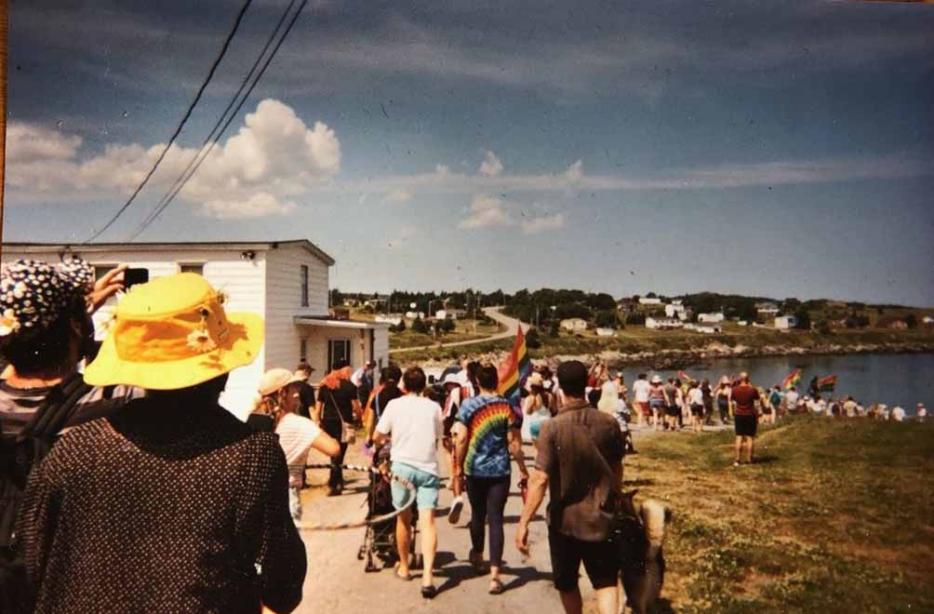
Wanda did organize a pride parade the following year. The parades are now a tradition in Broad Cove and in 2023, my girlfriend, Destiny, and I were able to attend. We drove a borrowed quad with rainbow leis twisted around the front rack. As we were leaving the parking lot of the Salem Community Centre, after some opening speeches and a performance of “What’s Going On” by a younger local musician, Kellie Loder, our bike stalled out. My aunt’s friend Carol, who was behind us in the line of idling all-terrain vehicles, hopped down and showed us how to stand as you rip the starting cable to get as much momentum and force as possible. After a few demonstrations, Destiny tugged the cord the way Carol showed us, and the bike roared to life.